Why Quality Control Decides Your Swimwear Brand’s Reputation
In swimwear e-commerce, sizing and quality problems are the number one reason customers return products — and a single batch of defective bikinis can destroy months of marketing investment. That is why professional buyers never rely on a factory’s promises alone. They rely on a documented, statistical quality control system called AQL. This guide explains how AQL works, what AQL 2.5 really means, and how to build a quality plan your swimwear manufacturer can actually deliver.
Learn more: AQL 2.5 quality control at Yucai · Related: first order checklist.
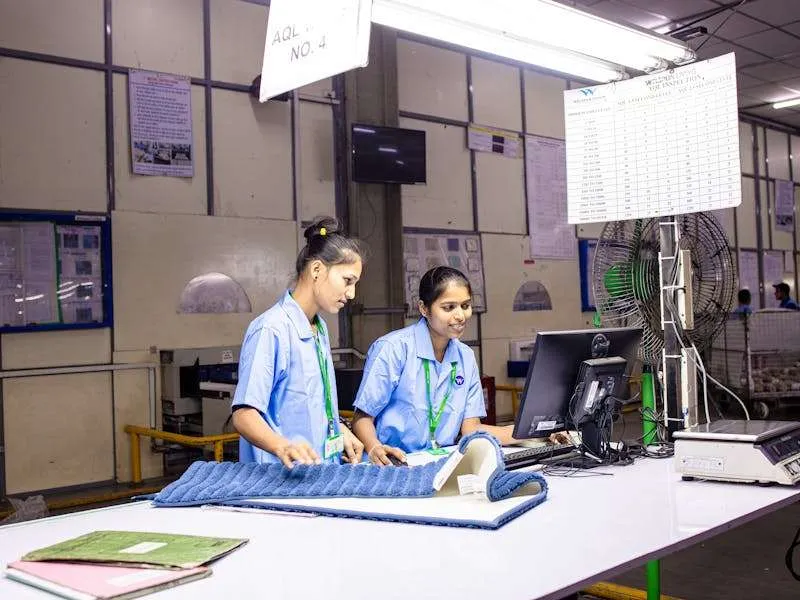
What Is AQL?
AQL stands for Acceptable Quality Limit. It is a statistical sampling method, defined by international standard ISO 2859-1, that lets a buyer verify the quality of a large production batch by inspecting only a representative sample. Rather than checking every single piece, an inspector randomly draws a defined number of items, checks them against a defect checklist, and decides whether the whole batch is acceptable or rejected. It is the industry standard used by importers, retailers, and third-party inspection companies worldwide.
How AQL Sampling Works
- Define the batch size — the total number of identical items in your order (e.g. 1,000 pieces of one colorway).
- Choose the inspection level — General Inspection Level II is the default for most apparel; Level III for high-risk categories like kids’ swimwear.
- Read the sample size code letter — ISO 2859-1 tables convert your batch size and inspection level into a sample size. For example, a batch of 501–1,200 pieces at Level II gives sample code G, meaning 32 pieces are inspected.
- Apply the AQL limits — the table tells you how many defects are acceptable. At AQL 2.5 for that sample of 32, the batch is accepted with 2 or fewer major defects and rejected at 3 or more.
AQL is not zero tolerance — it mathematically accepts a small, defined level of defects. This is realistic and keeps inspection costs proportionate to the order value.
What AQL 2.5 Means in Practice
Defects in apparel inspection are grouped into three classes:
- Critical defects — safety or regulatory issues (e.g. a sharp metal component, banned substance in fabric). Acceptable limit is almost always 0.
- Major defects — problems affecting wear or function (broken stitching, exposed elastic, off-size, print peeling).
- Minor defects — cosmetic issues that do not affect function (loose thread, slight color variation).
“AQL 2.5” normally refers to the acceptable limit for major defects. A well-specified order might use AQL 2.5 for majors and AQL 4.0 for minors, with 0 for criticals — but many brands simply specify a uniform AQL 2.5 and put the full detail in the inspection checklist.
Swimwear-Specific Defects to Put on Your Checklist
- Stitching integrity — skipped stitches, broken needles, loose thread tension around cups and gussets
- Elastic recovery — stretched-out leg openings or bands that no longer snap back
- Seam strength under chlorine and salt — swimwear seams face far more stress than ordinary garments
- Print and coating adhesion — peeling, cracking, or sticky prints after wear and washing
- Color fastness — color transfer, bleeding, or fading after washing and sun exposure
- Size consistency — graded set (XS–XL) that matches the agreed size spec
- Lining and coverage — correctly aligned linings, gussets, and modesty panels
Handing your manufacturer this checklist at the sampling stage means they build the requirements into production, not just into the final inspection.
The Three-Stage Inspection Process
The most effective QC is not a single pre-shipment check. It is a system spread across production:
- Incoming fabric inspection — verifying fabric weight, shrinkage, color, and test reports before cutting begins.
- In-process inspection — checking sewing quality, elastic attachment, and prints during production so defects are caught early, not after 10,000 pieces are sewn.
- Pre-shipment inspection — the AQL random sample on finished, packed goods before container loading, checking sizes, labels, packaging, and barcoding.
You can also add a fourth stage: a pre-production sample review, where you approve fit, color, and trims before mass production starts.
Who Should Perform the Inspection?
Three options exist, and professional buyers often combine them:
- Factory QC — fastest and cheapest, but you rely on the factory’s own team. Always ask how their internal inspection is structured.
- Third-party inspection — companies such as SGS, Intertek, or QIMA perform the AQL inspection on your behalf and issue an independent report.
- Your own quality engineer — most thorough for large, repeat orders; you travel to or permanently base a QC at the factory.
Whatever option you choose, require a written inspection report with photos of defects and clear accept/reject decisions per shipment.
How YucaiFJ Implements Quality Control
Quality control is built into YucaiFJ’s production system rather than bolted on at the end:
- AQL 2.5 inspection standard across all orders, with three-stage inspection: fabric incoming, in-process, and pre-shipment
- 100% of pieces checked at key points, with a defect rate of ≤ 0.5%
- An in-house testing laboratory supporting routine chemical and physical testing
- Full inspection reports provided with every shipment, including photo documentation
- An AQL-certified QC manager leading the inspection team, with every batch traceable from raw material to container loading
For a deeper look at the wider sourcing process, see our guide to choosing a reliable swimwear manufacturer in China, and our overview of swimwear fabrics.
Getting Started
Send your product brief or reference styles to [email protected] or WhatsApp +86 159 6009 9446, and our team will respond within 4 business hours with a production quote, a sample timeline, and the exact AQL inspection plan that will apply to your order.
Inspection Cost and Timing: What to Expect
A pre-shipment AQL inspection is a small, fixed cost compared to the order value — typically a modest per-manday charge plus travel for a third-party inspector. It adds 1-2 days to your schedule and gives you an independent accept/reject decision with photos. For a first order or a high-value line, it is the cheapest insurance you will buy.
If you use third-party inspectors such as SGS or Intertek, book the inspection date as soon as production starts, not when the goods are finished — inspection slots fill up fast in peak season.
Can the factory provide its own AQL inspection report?
Yes. A factory with an in-house QC team can issue its own AQL inspection report with photo documentation. Many buyers accept the factory report for routine reorders and bring in a third party for the first order or for high-risk lines. The key is that the standard (AQL 2.5) and the checklist are written into the quotation either way.
FAQ
What is AQL and why does it matter?
AQL (Acceptable Quality Limit) is a statistical sampling standard that defines how many defects are acceptable in a batch. AQL 2.5 is the common industry standard for swimwear.
What defects should a swimwear buyer check?
Key swimwear defects include color fading, seam puckering, elastic recovery issues, print misalignment and sizing inconsistencies.